
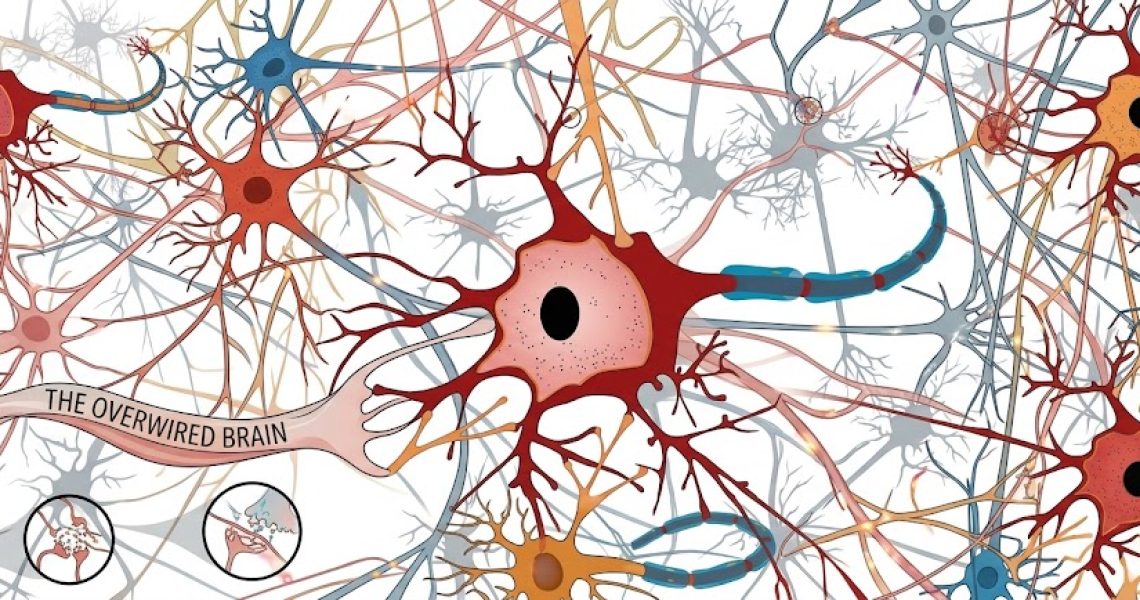

Scientists are studying how the autistic brain is wired. One important idea is ‘over-wiring’. It could help explain why some children on the autism spectrum find everyday sensory inputs — sounds, lights, and touch — overwhelming. It could also help us to better help them manage their learning and everyday lives.
💡 We’re also often asked about the genetics of autism. Research shows that many genes are involved. There’s unlikely ever to be one clear ‘marker’ gene to explain it.
How the Brain's Wired
A synapse is a connection that lets nerve cells in the brain ‘talk’ to each other.
- In the first few years of life, a child’s brain makes more than 1 million new connections every second.
- As the child grows, the brain cuts back the connections it does not need. This is referred to as pruning.
- Pruning helps the brain become more efficient. Different areas can then focus on their own jobs without being overloaded.
It’s a bit like a gardener trimming a hedge so that it grows strong and healthy and in a clear shape.
Extra ‘Brain Talk’ in Autism
A well-respected study from Columbia University looked at brains from children and teenagers. The study findings describe the brain wiring differences.
- By late childhood, children without autism had lost about half of their early connections, as expected.
- Children with autism had lost only about 16%.
- The problem was not that the brain made too many connections, It was that the brain did not clear away the extra ones appropriately.
(Read the report here: Extra Synapses in the Brain.)
'Over-Wiring’ Shows Up in Lived Experiences
When there are too many connections, some parts of the brain may receive more signals than they can handle.
This helps explain why many autistic children are very sensitive to sound and noise, bright lights, and touch.
In simple terms, their brains may be dealing with too much input all at once.

Practice Builds Strong Pathways
There’s encouraging news: the brain can change! (The formal term is ‘neuroplasticity’.)
Each time a child practises a skill, the brain uses the same pathway again. Pathways that are used often become stronger. Connections that are not used are pruned away. You can think of it as ‘use it or lose it’.
- A review of brain-scan studies of children and teenagers found that 87% showed changes in the brain after training or practice. (Read the report here: Training-Induced Neural Plasticity.)
It’s clear: learning and repitition help shape the brain.
Mindstretch Helps Build Strong Brains and Solid Skills
At Mindstretch, we focus on building strong positive neural pathways. We think of these as the brain ‘super-highways’ to support learning.
We do this through:
- Carefully planned learning and physical activities, repeated often so that skills become easier and more familiar over time.
- Giving HANDLE Therapy every day.
- A calm, supportive environment, ensuring that children are not overloaded and can focus on learning.
Every brain is different, and the story can change with age. It’s why we individualize our teaching, ensuring a child gets extra help in the areas they need. We do this in a personalized age- and grade-specific manner.

Want to learn more?
To learn more about how children’s brains grow and change, visit the Harvard Center on the Developing Child.
To find out how Mindstretch could support your child, please Contact Us.
Our individualized teaching lets every child reach their full potential, in line with their dreams and interests.