

At Mindstretch, we support children with learning challenges up to Grade R. Along the way, some children need a formal assessment that looks at their thinking and learning skills. This may be needed before a child moves on to their next school.
Too often, we find that the assessment results don’t truly show what a learner can do. The testing environment can be part of the issue. Formal assessments cost money and take time. They also matter a great deal — the results can shape a child’s future.
Our observations triggered this article. We hope the guidance will help you ensure your child’s assessment is as fair and stress-free as possible.
A Strange Place can Mean a Lower Score
Many of us don’t like sudden change. Children on the autism spectrum can find it especially hard.
A new building. New faces. Unexpected sounds, smells and sights. It can all feel overwhelming.
So, it’s no surprise that we sometimes meet bright children with real potential, only to find their assessment results are lower than expected.
The Problem May be the Pressure to Perform
Often the problem is not the child, it’s the situation and setting.
During an assessment, a child often has to deal with a lot change and pressure.
- They’re taken to a new place they’ve never seen before.
- They meet an adult they do not know.
- Suddenly they find they’re the centre of attention.
- There’s a need to ‘perform’ on demand.
It can be a lot for a sensitive child to cope with.
Of course, our children must learn to handle real-world pressure, but it’s a skill they build over time, through good parenting and caring teaching in a supportive environment.
We shouldn’t test a child’s ability to deal with pressure at the same time we test their congnitive abilities.
What the Research Tells Us
The choice of setting can have a major impact:
- A 2024 review found that busy places, noise, bright lights, strong smells and new people can overwhelm children on the autism spectrum. This can make it harder for them to focus and communicate, and can increase anxiety.
- Read more here: Autism-Friendly Care.
The style of the test matters a lot:
- A study of 30 autistic children with little or no speech found none could complete a standard, language-heavy IQ test. But on a picture-based puzzle test, about 65% scored in the typical range.
- Read more here: Tests Underestimate Non-Verbal Children.
A known adult scorer increases the score:
- A study of young children with autism found that children tested by a known adult scored noticeably higher than those tested by a stranger. The researchers advise that testers meet the child before the test.
- Read more here: Examiner Familiarity Effects.
It’s clear: how and where a child is tested can change the result.
Our Advice to Parents
Where possible, ask for your child’s assessment to address these points.
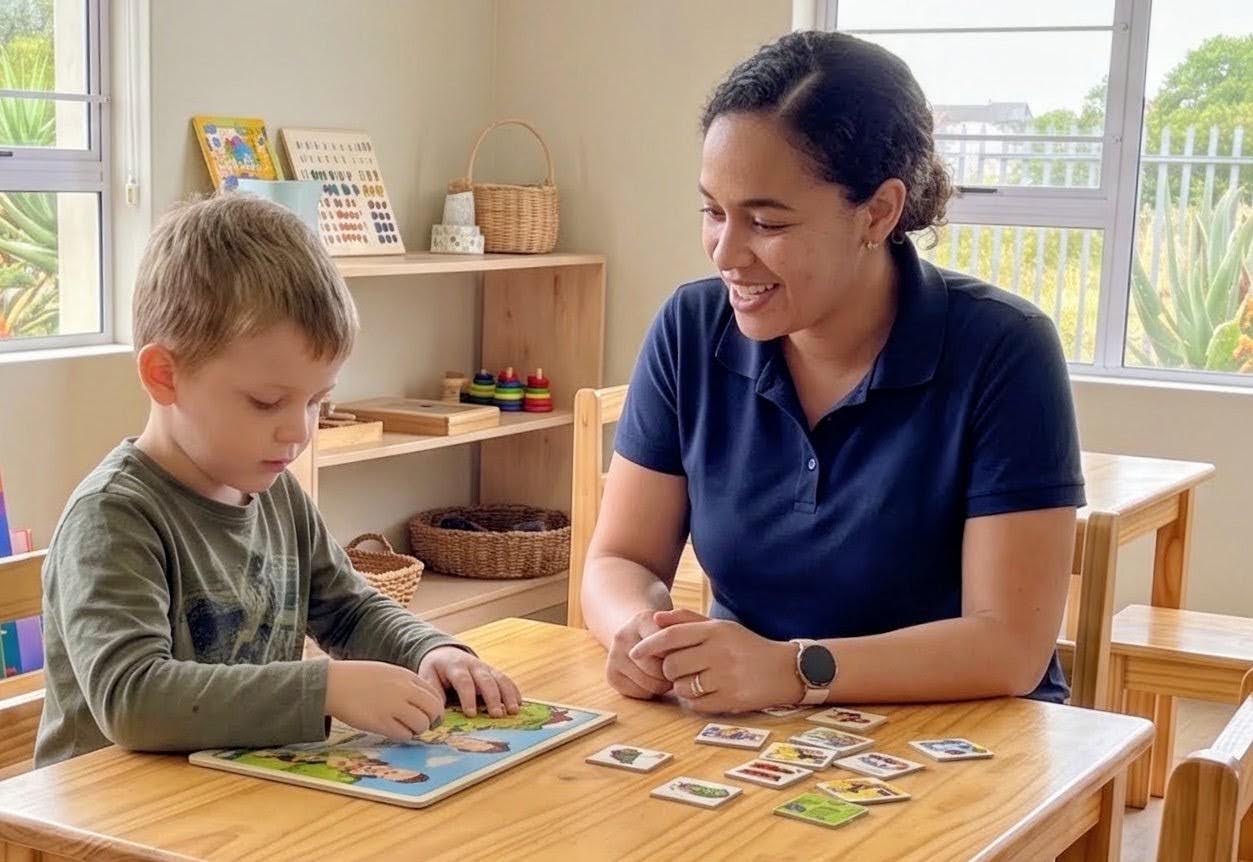
- Done by a friendly face. Ideally by someone your child already knows, or at least someone they have met and feel comfortable with before the test.
- Held in a familiar, calm place with suitable lighting and reduced noise.
- Be free from rushing and avoid unnecessary pressure.
- No more than one test on a single day.
Please also ensure your child is calm and rested before attending an assessment. Our article Calming Interventions gives some ideas. Or try our Soothing Spinal Massage.
A Private Room at Mindstretch
Mindstretch makes a private room available for assessments, on request.
This means your child can be assessed at our school, a safe environment they know and trust. Because our learners feel comfortable here, they are more likely to show what they can really do.
Please speak to us if you’d like to arrange this.
Mindstretch cares and so we offer a safe, calm space for assessments.
We’re located in Pinelands, Cape Town. Join us — we’ll help your child build their skills and knowledge one block at a time.