


Hearing and listening skills help children make sense of sounds around them, like voices and noises. These skills let kids focus on important sounds, understand words, and ignore background noise.
Children with autism or learning challenges often find this hard. This can affect talking, reading, and spelling.
🩵 Check out our related article on movement and the vestibular system.
The Difference Between Hearing and Listening
Good hearing picks up sounds, while listening means understanding them.
Why Hearing and Listening Skills are Key
Strong auditory memory helps children remember short bits of information to learn new things. At Mindstretch, we use these ideas to help children build key listening skills. We encourage our parents to do the same at home.
Below are some GAMES to try at home.
- Tailor games to your child’s needs, starting simple. Practice often for best results.
Hearing and Listening: Basic Beginnings
FIND THE SOUND
This game wakes up your child’s ears to noises around them. Do it daily for a few minutes. No toys needed.
- Sit quietly together in a room, and point out simple sounds: “Do you hear the clock ticking?” Or, “water running in the sink?”
- When your child says Yes or nods their head, show them what makes the noise (like lifting the clock or turning on the tap). Name the thing: “That’s the clock!”
- Try 3-4 sounds per game — for example, add in a door creak or fan hum.
- Praise your child: “Good listening!” Do it daily for a few minutes.
COPY ME
This builds sound imitation, a first step to talking. Keep it short and fun.
- Make one easy animal or car sound: “moo” (for cow) or “vroom” (for car).
- Give them a turn: “Your turn, copy me.” Smile big and wait.
- Cheer them on when they try.
- Do just one sound at a time. Switch sounds next round (eg, “meow” for cat).
- Play the game a few times a day, perhaps before meals – laughter helps!
Hearing and Listening: Next Steps
GUESS WITH EYES CLOSED
This sharpens listening without sight — use it after mastering basic sound finding.
- Have your child close their eyes (or use a soft blindfold if they like it).
- Make one clear household sound nearby: clap hands, drop a spoon on the table, or open a squeaky door.
- Ask: “What was that sound?” Help with a hint if needed, like “It was my hands.”
- Name the sound together: “Yes, a clap!”
- Try 3-4 sounds per turn, like footsteps or crumpling paper.
- Switch it up: Let them make sounds for you to guess. Laugh and cheer every try.

ANIMAL MEMORY CHAIN
This builds memory and recall.
- Gather toy animals or animal pictures (like dog, pig, or cow).
- Start easy: Make one animal sound (e.g., “woof” for dog). Ask your child, “Which animal is that?” Have them point to it.
- Next step: Make two sounds in a row (eg, “woof-woof, oink”). Have your child point to both animals in the right order.
- When they’re good at two, add a third. Keep practicing at the level where they start to find it tricky – this builds memory.
- Mix up the order each time. For fun, pretend to get it wrong sometimes (e.g., point to the wrong animal) — your child will love laughing at that!
Hearing and Listening: Advanced Levels
SOUND ‘I SPY’
This helps with hearing the first sound in words (like /b/ in ‘ball’).
- Use things nearby and pick an easy object (like a ball or book).
- Say: “I spy with my little eye something starting with the /b/ sound.” (Say the sound: ‘buh’, not the letter name ‘bee’)
- Let your child guess and point to it. Give hints if needed: “It’s round and bouncy.”
- Start with obvious items to build confidence and take turns.
- Play often, like in the car or when waiting in line.
CLUE GAME — DESCRIPTIVE ‘I SPY’
This teaches listening to details and following descriptions.
- Look around you and pick something simple (like a ball).
- Give 2–3 clues one by one: “It’s round. It bounces. We play with it outside.”
- Have your child guess the object.
- Use 3 clues max to keep it fun and not too hard.
- Switch roles: they give clues, you guess (act silly if you ‘miss’ it).
SHOPPING LIST MEMORY GAME
Builds remembering longer lists of words in order. It’s great for shopping trips.
- Start with two items: “I went shopping and bought apple, then bread”. Have your child repeat both objects.
- Add one more thing when ready: “Apple, bread, milk.” They say it back.
- Keep going slowly: “Apple, bread, milk, eggs.”
- Stop if you see them getting bored or frustrated.
- Practice their turn: They start the list, and you add on.
- Using actual shopping words to make it feel more real and exciting.
SHOW GOOD LISTENING
Children copy what you do every day.
Show them how to be a good listener: look at your child when they speak, keep eye contact, stay quiet, nod, and don’t interrupt.
TALK A LOT!
Chat with your child as often as you can — real conversation beats any game.
WHEN TO SEEK HELP
If you’re worried about your child’s speech or listening skills, it’s best to get help early. Some signs to look out for include: your child not babbling or using many sounds as a toddler, being hard to understand, struggling to follow simple instructions, or getting very frustrated when trying to talk. If you notice these, speak to your paediatrician or a speech therapist.
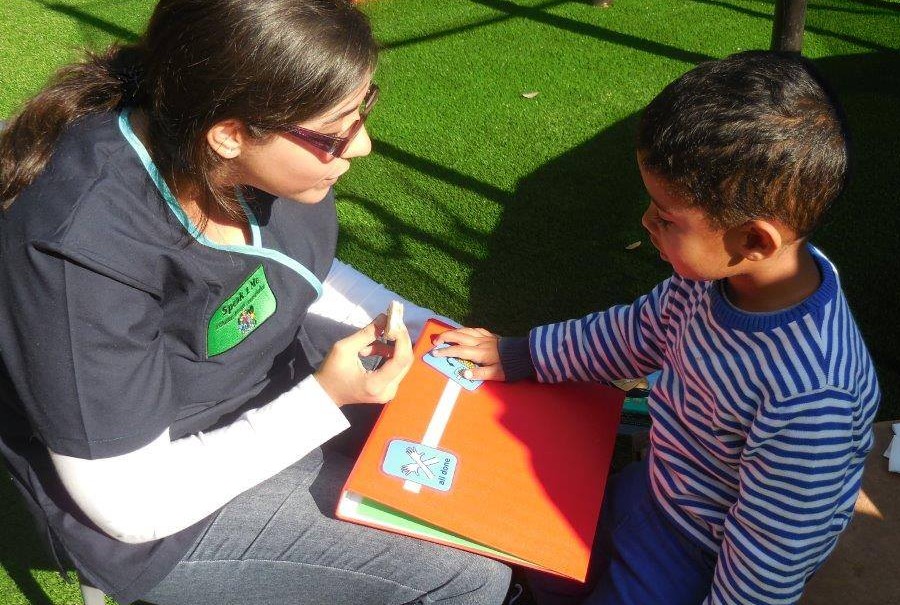
At Mindstretch, we can guide and connect you with trusted speech therapists who work at our school.
Speech therapy is available on an extramural basis at Mindstretch, as provided on our premises.
BE IN TOUCH
Our Mindstretch science-based approach complements home efforts, fostering progress in a nurturing environment for children with learning challenges. Send us a message via our website or call us on 021 531 5899.